As I write this post, I find myself contemplating convergence... of new life coming and another ending.
Much of what drives the content of this site is the convergence of generations - the boomers, the gen Xers and gen Y.
As we wait in anticipation of our baby girl, my mum is dying. How more convergent do the generations get?
There is much to look forward to.
Showing posts with label time. Show all posts
Showing posts with label time. Show all posts
Monday, December 18, 2006


Tuesday, September 26, 2006
Crikey: Life's an Adventure
The deaths of wildlife warrior Steve Irwin on Monday Sep 4, and then motor racing hero Peter Brock in quick succession on Friday September 8 has given many of us pause to reflect.
Both were men of renown, with Brock, the stuff of legend in the Australian car racing scene over three decades, and Irwin the cocodile hunter having established fame on a world stage.
Like many Australians, I mourn their deaths - both sudden and unexpected, though both somewhat predictable in hind-sight. "Death by mis-adventure" is what will probably appear on their death certificates. "Life lived as an adventure," I would also like to think.
There are so many elements and so much has been recorded about the lives of Steve Irwin and Peter Brock, so my own contribution to the musings is modest. I simply acknowledge that they gave so many people hope.
They successfully tapped into and effectively influenced multi-generations - Brock, a War baby in his sixties, had a legion of fans across Boomers, Gen X and even Gen Ys. Steve Irwin had universal appeal across generations, across cultures and across the globe. Both brought messages of value to millions. Messages of passion, safety and the environment.
We all feel a little sad, and sympathetic towards those closest to these remarkable Australians. In time, we can see them as figures who helped shape or define our world and maybe even who we are or aspire to be like.
Mostly, I hope it gives us another reminder to be glad of our God-given time, that even our heroes are fallible and our human condition is frail, so we should all make the most of our time, our skills and our gifts - and inspire others to do the same.
Crikey, Steve and Brocky sure did!
Both were men of renown, with Brock, the stuff of legend in the Australian car racing scene over three decades, and Irwin the cocodile hunter having established fame on a world stage.
Like many Australians, I mourn their deaths - both sudden and unexpected, though both somewhat predictable in hind-sight. "Death by mis-adventure" is what will probably appear on their death certificates. "Life lived as an adventure," I would also like to think.
There are so many elements and so much has been recorded about the lives of Steve Irwin and Peter Brock, so my own contribution to the musings is modest. I simply acknowledge that they gave so many people hope.
They successfully tapped into and effectively influenced multi-generations - Brock, a War baby in his sixties, had a legion of fans across Boomers, Gen X and even Gen Ys. Steve Irwin had universal appeal across generations, across cultures and across the globe. Both brought messages of value to millions. Messages of passion, safety and the environment.
We all feel a little sad, and sympathetic towards those closest to these remarkable Australians. In time, we can see them as figures who helped shape or define our world and maybe even who we are or aspire to be like.
Mostly, I hope it gives us another reminder to be glad of our God-given time, that even our heroes are fallible and our human condition is frail, so we should all make the most of our time, our skills and our gifts - and inspire others to do the same.
Crikey, Steve and Brocky sure did!
Monday, August 21, 2006
School Reunion, so much more than reminiscing
Still feeling the rush of the good vibes of our US visit, Martha's high school reunion provided so much more than reminiscence and curiosity sating.
Last weekend in Iowa City, I accompanied my darling wife to her twenty year High School reunion. In all our previous visits to the US, we had never ventured beyond the Minnesota border, so the road trip alone was always going to be exciting.
[NOTE TO DEAR FRIENDS AND FAMILY IN THE TWIN CITIES: I love spending time with you, and most of my time in the USA in Minnesota. The chance to learn more about Martha's past in Iowa is just too enticing]
Here are a few of my experiences and observations:
Our hosts, Bret and Val, are a couple of the world's best quality and nicest people. Bret, a long term P&G company man (and Martha's class mate) represents so much of all that is good about the USA and peace-loving Americans. He is a seriously good guy, and had he not been such good friends with Martha, probably would have married or at least, dated her.
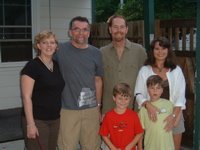 His wife Valerie, also a native Iowan and a damn fine theatre nurse, exudes intelligence, compassion, empathy and love. She is someone who has accepted some challenges, including those associated with having a brain injured child. She lives her life in a way that brings joy to many, especially Bret, Orion and Aiden, and leaves no doubt in anyone else's mind that they can participate, co-operate, share it... or get out of the way. She makes good decisions. As a couple, Bret and Val support each other and could epitomise the good stuff we scarcely hear about Americans these days.
The reunion of West High's Class of 86
The fact that there were two high schools - "City" and "West" in Iowa City speaks volumes. No stories of when "we beat City" or claims of victorious raids or other rivalry, just a calm recognition that, although City won everything, we are proud of our West heritage.
Bret, surrounded by classmates, some who had travelled a long way to be there and some of whom still live locally but with whom he had lost contact, could not stop beaming. This was infectious.
"Brian," and you know who you are, re-introduced himself to my increasingly beaming wife as the boy she had kissed - his first snog. Martha later told me that there were at least five classmates there that she had snogged.
As a classmate's spouse, I felt welcome and increasingly curious to learn about what such a significant part of my significant other's life represented. It was fun to meet other people in a true spirit of friendship and celebration, and where most were able to check any remaining high school insecurities at the door.
As the only Australian present, it was easy to converse with everyone. My name tag, like all of the name tags of the classmate spouses, was inscribed with the name of the respective classmate to whom I am married. It gave me a good sense of authentication, and secretly, I was thinking "well she night have dated or snogged you, but she married me!" Perhaps not all of us checked their insecurities at the door, after all!
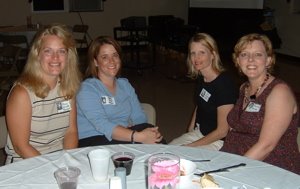 High school crushes, friendships renewed, contact details updated, reminiscing complete for now, the ripple effects of the event will continue. Who knows what will happen to this remarkable group of people who happened to form the graduating class of West High 1986 in the next twenty years? If I am invited, I for one want to know. What a wonderful collection of Gen-X, and now, all with a permanent link with this Boomer.
More about the road trip and our reunion visit with a great friend in North Dakota in the next post.
Last weekend in Iowa City, I accompanied my darling wife to her twenty year High School reunion. In all our previous visits to the US, we had never ventured beyond the Minnesota border, so the road trip alone was always going to be exciting.
[NOTE TO DEAR FRIENDS AND FAMILY IN THE TWIN CITIES: I love spending time with you, and most of my time in the USA in Minnesota. The chance to learn more about Martha's past in Iowa is just too enticing]
Here are a few of my experiences and observations:
Our hosts, Bret and Val, are a couple of the world's best quality and nicest people. Bret, a long term P&G company man (and Martha's class mate) represents so much of all that is good about the USA and peace-loving Americans. He is a seriously good guy, and had he not been such good friends with Martha, probably would have married or at least, dated her.
 His wife Valerie, also a native Iowan and a damn fine theatre nurse, exudes intelligence, compassion, empathy and love. She is someone who has accepted some challenges, including those associated with having a brain injured child. She lives her life in a way that brings joy to many, especially Bret, Orion and Aiden, and leaves no doubt in anyone else's mind that they can participate, co-operate, share it... or get out of the way. She makes good decisions. As a couple, Bret and Val support each other and could epitomise the good stuff we scarcely hear about Americans these days.
The reunion of West High's Class of 86
The fact that there were two high schools - "City" and "West" in Iowa City speaks volumes. No stories of when "we beat City" or claims of victorious raids or other rivalry, just a calm recognition that, although City won everything, we are proud of our West heritage.
Bret, surrounded by classmates, some who had travelled a long way to be there and some of whom still live locally but with whom he had lost contact, could not stop beaming. This was infectious.
"Brian," and you know who you are, re-introduced himself to my increasingly beaming wife as the boy she had kissed - his first snog. Martha later told me that there were at least five classmates there that she had snogged.
As a classmate's spouse, I felt welcome and increasingly curious to learn about what such a significant part of my significant other's life represented. It was fun to meet other people in a true spirit of friendship and celebration, and where most were able to check any remaining high school insecurities at the door.
As the only Australian present, it was easy to converse with everyone. My name tag, like all of the name tags of the classmate spouses, was inscribed with the name of the respective classmate to whom I am married. It gave me a good sense of authentication, and secretly, I was thinking "well she night have dated or snogged you, but she married me!" Perhaps not all of us checked their insecurities at the door, after all!
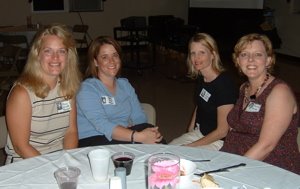 High school crushes, friendships renewed, contact details updated, reminiscing complete for now, the ripple effects of the event will continue. Who knows what will happen to this remarkable group of people who happened to form the graduating class of West High 1986 in the next twenty years? If I am invited, I for one want to know. What a wonderful collection of Gen-X, and now, all with a permanent link with this Boomer.
More about the road trip and our reunion visit with a great friend in North Dakota in the next post.
Wednesday, May 03, 2006
Time to make a living
A recent post on Squash that alludes to time "Making a living in the smallest possible time" caused me to reflect (and I had the time!)
In it, Phil Sim credits Paul Graham with some commentary that supports the idea encapsulated in the heading. Not far beneath the surface of this commentary is some sadness. While I hope that neither Phil or Paul have recently experienced bereavement, nothing makes us more respectful of time than death.
Other than actual death, everything else is an artificial deadline. And in our extravagant use of language in business, we speak of deadlines, even drop deadlines. Our lives - and our computers, the Internet and virtual worlds - are defined by chronology. This is a universally accepted measure broken into years, months, days, hours... nanoseconds.
As Phil seems to imply, I completely support the idea of making a living in the smallest possible. I spend time dreaming of ways to earn a living that will support me without taking up my time. I have a long list of things I'd like to be doing other than making a living, and I am forced by my circumstances, nature and patterns of behaviour to compromise this conflict.
 We speak of realtime, Internet time, face time and "time for a chat" (usually not good)
Recently, I have come to understand time in a different boomerexy way.
Theologians, philosophers and rhetoricians make various interpretations of kairos. To me, kairos captures those moments in your life that give it definition. The time you kissed, had sex, proposed, married, became a parent, got fired, dumped or failed some test, won something or were elevated in some way for the first time.
While chronos time ticks along as I contemplate making a living in the smallest possible time, it's kairos moments for which I live. I'm no less committed to getting the money thing sorted out, and I am increasingly conscious of leveraging my making-a-living-days more effective, but kairos time can not be compressed. After all, how long does a decision take? Not the processing, contemplation, procrastination... a decision.
Seems we're all a few (kairos) decisions away from making a living. In the meanwhile, using your precious chronological allocation to hug someone you love (or better still, tell them), be with them or do that thing you've been meaning to, it's a small concession with potentially great reward. Do it even if, as a result, it takes you a moment longer to make your living.
In it, Phil Sim credits Paul Graham with some commentary that supports the idea encapsulated in the heading. Not far beneath the surface of this commentary is some sadness. While I hope that neither Phil or Paul have recently experienced bereavement, nothing makes us more respectful of time than death.
Other than actual death, everything else is an artificial deadline. And in our extravagant use of language in business, we speak of deadlines, even drop deadlines. Our lives - and our computers, the Internet and virtual worlds - are defined by chronology. This is a universally accepted measure broken into years, months, days, hours... nanoseconds.
As Phil seems to imply, I completely support the idea of making a living in the smallest possible. I spend time dreaming of ways to earn a living that will support me without taking up my time. I have a long list of things I'd like to be doing other than making a living, and I am forced by my circumstances, nature and patterns of behaviour to compromise this conflict.
 We speak of realtime, Internet time, face time and "time for a chat" (usually not good)
Recently, I have come to understand time in a different boomerexy way.
Theologians, philosophers and rhetoricians make various interpretations of kairos. To me, kairos captures those moments in your life that give it definition. The time you kissed, had sex, proposed, married, became a parent, got fired, dumped or failed some test, won something or were elevated in some way for the first time.
While chronos time ticks along as I contemplate making a living in the smallest possible time, it's kairos moments for which I live. I'm no less committed to getting the money thing sorted out, and I am increasingly conscious of leveraging my making-a-living-days more effective, but kairos time can not be compressed. After all, how long does a decision take? Not the processing, contemplation, procrastination... a decision.
Seems we're all a few (kairos) decisions away from making a living. In the meanwhile, using your precious chronological allocation to hug someone you love (or better still, tell them), be with them or do that thing you've been meaning to, it's a small concession with potentially great reward. Do it even if, as a result, it takes you a moment longer to make your living.
Friday, April 28, 2006
ANZACS and Living in a TRADITIONAL Internet Age
We just celebrated – if that’s the right word – ANZAC Day in Australia (April 25), a day that is not only the most universally acknowledged national holiday in Australia (quite a few people have issues with “Australia day”), but one that continues to attract cross generational appeal.
The story of incredible loss and sacrifice combined with courage and a barely understood quality called Aussie mateship gave rise to the ANZAC spirit. It took another world war and more than twenty years before a fledgling tradition was claimed.
Those who were there at the time remember. Those who grew up with the aforementioned and heard the stories honour them. Those who are not connected by family links to ANZACS have learned to respect what it all means. And now, two or three generations on, ANZAC Day is a time-honoured tradition.
As my first post, and with respect, hopefully not my last post, I have been wondering what it takes to establish a time-honoured tradition. For many, the concept of Internet time has changed the reference points for time. We have come to expect information, goods and services, relationships, transactions, education, negotiations, consultations, aggregations and almost every other *ation to be available instantly. The concept of delayed gratification is academic or even quaint.
This is not a rant about Internet time, just a slowly cooked opinion that time and tradition are NOT relative terms, nor can either be hurried up. We live in an age that readily dismisses traditions or traditional approaches, yet one that desperately wants to establish them. I’ve heard the qualifier “traditionally” applied to sporting teams with barely a decade of history, to TV talent shows after three consecutive seasons (can anyone name our first three Australian Idols), and even to computer operating systems (ahh Windows 3.x).
Will any of our stories of today become true traditions? What will the benchmark for “time-honoured” be? My guess is that we will find tenuous links being made to or claimed as traditions. On a global scale, traditions can be established as quickly as a major act of terrorism or some natural catastrophe occurs.
But tradition is not a currency easily acquired. While the Internet, and especially Web 2.x offers us who are blessed to live in a free and technology accessible nation the chance to share it, learn it and even influence it a little, I just wonder what traditions we will leave behind us.
Perhaps in a generation or two, people will be reading these blogs in the same way we flick through our grandparents’ letters or diaries from a bygone time.
For any traditionalist who happens to land on this blog, hang in there, grab on to your seat, enjoy the ride, and know that YOUR knowledge of time-honoured tradition can not be overtaken. Who knows, it might be up to you to pass on the tradition.
Let’s hope it’s not only by blog or email.
The story of incredible loss and sacrifice combined with courage and a barely understood quality called Aussie mateship gave rise to the ANZAC spirit. It took another world war and more than twenty years before a fledgling tradition was claimed.
Those who were there at the time remember. Those who grew up with the aforementioned and heard the stories honour them. Those who are not connected by family links to ANZACS have learned to respect what it all means. And now, two or three generations on, ANZAC Day is a time-honoured tradition.
As my first post, and with respect, hopefully not my last post, I have been wondering what it takes to establish a time-honoured tradition. For many, the concept of Internet time has changed the reference points for time. We have come to expect information, goods and services, relationships, transactions, education, negotiations, consultations, aggregations and almost every other *ation to be available instantly. The concept of delayed gratification is academic or even quaint.
This is not a rant about Internet time, just a slowly cooked opinion that time and tradition are NOT relative terms, nor can either be hurried up. We live in an age that readily dismisses traditions or traditional approaches, yet one that desperately wants to establish them. I’ve heard the qualifier “traditionally” applied to sporting teams with barely a decade of history, to TV talent shows after three consecutive seasons (can anyone name our first three Australian Idols), and even to computer operating systems (ahh Windows 3.x).
Will any of our stories of today become true traditions? What will the benchmark for “time-honoured” be? My guess is that we will find tenuous links being made to or claimed as traditions. On a global scale, traditions can be established as quickly as a major act of terrorism or some natural catastrophe occurs.
But tradition is not a currency easily acquired. While the Internet, and especially Web 2.x offers us who are blessed to live in a free and technology accessible nation the chance to share it, learn it and even influence it a little, I just wonder what traditions we will leave behind us.
Perhaps in a generation or two, people will be reading these blogs in the same way we flick through our grandparents’ letters or diaries from a bygone time.
For any traditionalist who happens to land on this blog, hang in there, grab on to your seat, enjoy the ride, and know that YOUR knowledge of time-honoured tradition can not be overtaken. Who knows, it might be up to you to pass on the tradition.
Let’s hope it’s not only by blog or email.
Subscribe to:
Posts (Atom)